

The Leadership Reliability Index™
An enterprise-level early-warning instrument for leadership system health.
What it is:
A risk and reliability signal
A forward-looking indicator
Enterprise oversight and system resilience
What it is NOT:
Measure of leadership style, or general effectiveness
A performance rating, or employment decision tool
A judgement of intent, character, or effort
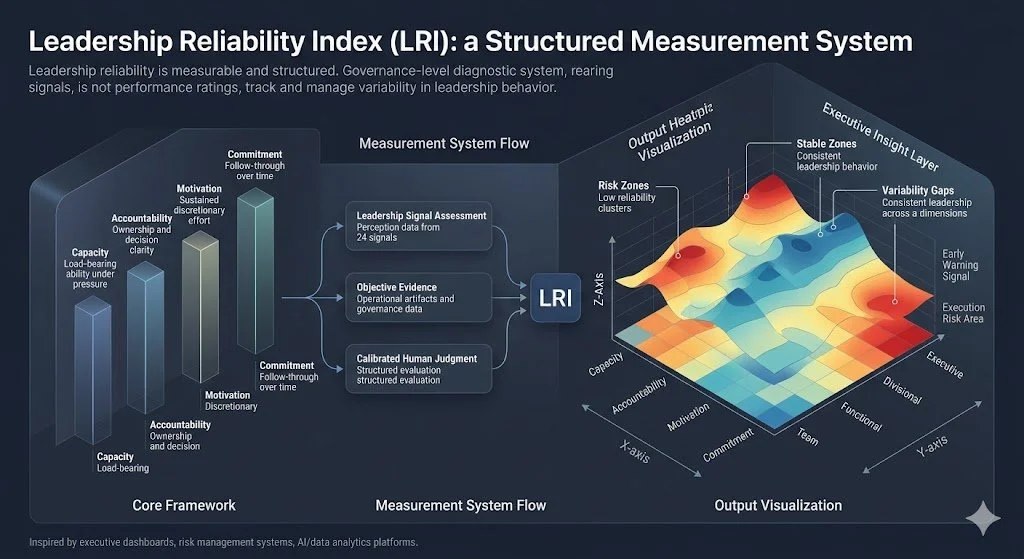
How it Works
Leadership Signal Assessment
Structured leadership feedback across four dimensions captures 24 distinct leadership signals reflecting how behaviors are experienced across the organization.
These signals reveal patterns in clarity, trust, and execution under pressure—highlighting where leadership variability is felt before it becomes measurable failure.Objective Evidence (Behavioral Validation)
Findings are validated through a pre-defined audit plan, ensuring systematic review of leadership behaviors against observable outputs and enterprise standards.
This anchors reliability in demonstrated behavior, corroborating perception data with objective proof and reducing interpretive bias.Calibrated Human Judgement
Trained evaluators interpret evidence across sources, reconciling conflicting signals through structured calibration.
This prevents over-reliance on any single data stream and ensures findings are decision-relevant and governance-ready.
Appropriate Executive Use
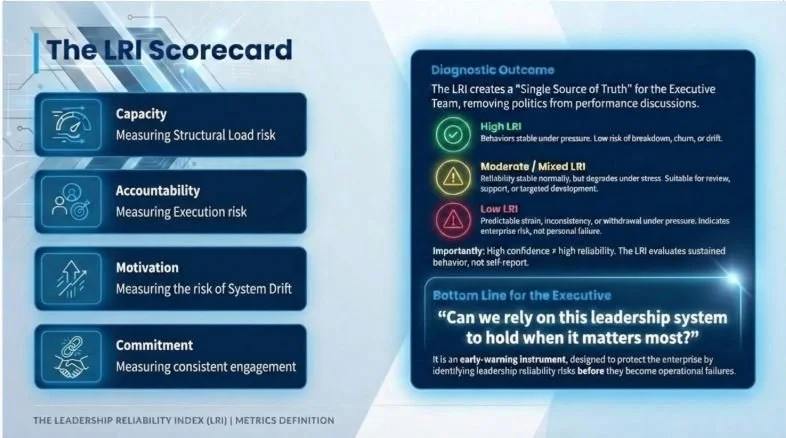
Monitor leadership system health
Inform succession readiness
Detect structural overload
Leadership Reliability Index™ Briefing
This 30-minute executive briefing is designed to assess the reliability of your leadership system and identify where variability may be impacting execution, accountability, and performance.
What to Expect
A focused discussion on leadership behavior under operational pressure
• Introduction to the Leadership Reliability Index™
• Early identification of potential reliability gaps and execution risk
• Clear next-step recommendations based on your organizational context